






Introduction
If good data is the fuel for voice AI, annotation is the refinery. It’s where messy, real‑world audio—cross‑talk, accents, filler words,and background noise—gets turned into structured training signal your models can learn from. Detailed guides on audio data labeling stress that high‑quality, consistent labels are one of the biggest levers you have for improving ASR and voice‑driven systems.
From our seat at Andovar, we’ve seen great models underperform simply because transcripts were inconsistent, speaker turns were mis‑segmented, or labels didn’t reflect real‑world usage. In this article,we’ll walk through the key challenges in speech and audio annotation, the best practices we follow in our multilingual data annotation services,and how to build human‑in‑the‑loop workflows that scale without sacrificing nuance.
This article is part of our broader speech data strategy playbook.
What does “speech and audio annotation” actually include?
Most people hear “annotation” and think “transcription,” but modern speech data projects usually need more. Comprehensive audio labeling guides list several layers:
- Transcription – Converting speech to text, with rules for punctuation, disfluencies, and code‑switching.
- Timestamps and segmentation – Aligning text with audio (per utterance or per word) and splitting long recordings into manageable segments.
- Speaker diarisation – Marking “who spoke when,” especially for multi‑party calls.
- Acoustic and event tags – Background noise, music, laughter, overlapping speech, non‑speech events.
- Higher‑level labels – Intent, sentiment, entities, or categories for audio classification tasks.
Audio labeling is an in-depth process of turning unstructured recordings into “precise, model‑ready datasets” through time stamped transcription, diarisation, event tagging, and careful handling of accents and disfluencies. That’s exactly the mindset we bring to our speech annotation projects.
What are the main challenges in speech annotation?
Even with good tools, speech annotation is hard. Third‑party resources highlight several recurring challenges:
- Ambiguous or noisy audio – Poor quality, heavy background noise, or overlapping speech makes it hard to hear precisely what was said.
- Accent and language variation – Annotators may mis‑hear unfamiliar accents or mixed‑language content.
- Inconsistent guidelines – If rules for punctuation, fillers, or partial words aren’t clear, annotators will diverge.
- Fatigue and scale – Listening and transcribing for hours is mentally demanding; error rates climb when people are tired.
- Atypical speech – Datasets including speech disorders or non‑standard speech present extra complexity, and studies caution that inconsistent annotation here can introduce biases.
Key challenges in speech annotation?
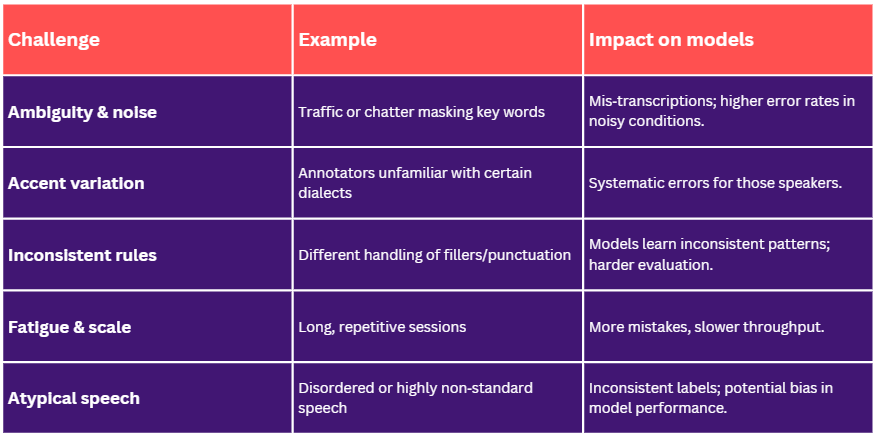
We tackle these with clear guidelines, targeted annotator training, and careful project design—especially when working with a typical or low‑resource speech.
Running into annotation quality issues?
If your transcripts and labels are inconsistent across languages or vendors, we can help redesign your guidelines and workflows, then relabel critical speech data through our multilingual data annotation services.
Fix your speech annotations

What are best practices for high‑quality audio annotation?
Best‑practice checklists for audio labeling converge on a few core ideas:
Define clear annotation guidelines
- Specify how to treat fillers (“um”, “uh”), false starts, dialectal variations, numbers, and punctuation.
- Include positive and negative examples; update guidelines as edge cases emerge.
Segment audio into manageable chunks
- Many sources recommend splitting long recordings into 30–120 second segments to reduce fatigue and improve accuracy.
- Non‑overlapping segments also help avoid data leakage between train/test splits.
Handle noise intentionally
- Clean up extreme noise that makes content unintelligible.
- But keep realistic background noise where appropriate so models learn to cope with real‑world conditions—something audio‑labeling guides call out as important for robustness.
Implement quality control and feedback loops
- Use spot checks, double‑labeling for a subset, and inter‑annotator agreement metrics.
- Set up a feedback loop so annotators can flag confusing cases and improve guidelines over time.
Train and support annotators
- Provide initial training and regular refreshers, especially when you add new labels or languages.
- Encourage regular breaks to mitigate fatigue, as some audio‑labeling guides explicitly recommend.
These are the same principles we embed in Andovar’s multilingual data annotation services, adapted to each project and language.
When should you use automation vs human annotation?
You don’t have to choose between “all manual” and “all automated.” Many practitioners, Including Andovar advocate semi‑automatic workflows, where models handle the easy parts and humans focus on nuance.
Common patterns include:
- ASR pre‑labeling – Use an existing ASR model to generate draft transcripts, then have human annotators correct them. This can significantly reduce turnaround time when audio quality is decent.
- Automatic segmentation and diarisation – Tools can pre‑split audio into segments and propose speaker turns; humans refine as needed.
- Automated checks – Scripts can flag obviously problematic segments (e.g., empty audio, extreme noise levels) before humans invest time.
Full automation remains risky, especially for noisy, multilingual, or atypical speech, and we recommend keeping humans in the loop for quality‑critical tasks. We follow the same approach: automation for speed, human reviewers for accuracy and cultural nuance.
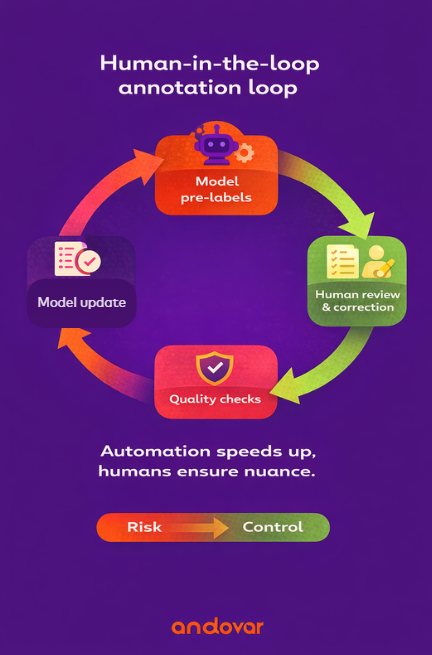
Want to add automation without losing label quality?
We can help you design human‑in‑the‑loop workflows that combine pre‑labeling with expert human review, tuned for your languages and domains.
Design my annotation workflow
How does good annotation support fairness and long‑term maintainability?
Annotation isn’t just a one‑off task; it shapes how your models behave over time. Our data experts in ASR labeling warn that inconsistent or biased annotation can reinforce disparities—for example, if annotators “correct” certain accents toward a perceived standard, or ignore disordered speech patterns in atypical speech datasets.
Good annotation practices help by:
- Capturing real variation instead of forcing everything into one “standard” speech pattern, which supports fairer models.
- Making error analysis possible because you have reliable transcripts and labels to compare against model outputs.
- Supporting future tasks since rich labels and timestamps allow you to re‑use the same speech data for new models without recollecting audio.
That’s why we treat annotation and labeling as part of the data infrastructure for our clients, not a disposable step. Consistent, well‑documented annotation makes it much easier to extend your models to new languages, domains, or evaluation metrics down the line.
Check out our broader speech data strategy playbook.
Andovar Use Case:
High-Precision Annotation for Call Center Analytics
Project Overview
Andovar provided annotation services for a 120,000+ hour multilingual call center dataset for a telecom giant, covering English, Portuguese, Indonesian, and Tagalog. This transformed raw support calls into precisely labeled training data for intent detection, sentiment analysis, and quality assurance AI.
Annotation Challenges Overcome
Complexity of audio
- Handled overlaps (multi-speaker diarization with 98% accuracy), heavy accents (phonetic transcription for low-resource dialects), background noise (tagged acoustic events like hold music or typing), and disfluencies (marked fillers like "uhm" or restarts).
- Inconsistent guidelines: Developed unified style guides with 50+ examples per label type, plus weekly calibration sessions—achieving 96% inter-annotator agreement via adjudication tools.
- Scale and fatigue: Broke long calls into 30s segments, rotated 500+ linguists across shifts, and used fatigue monitoring (error rates >5% triggered breaks), maintaining quality over 6 months.
- Deciding what to automate: Hybrid workflow—ASR pre-labels (Whisper fine-tuned on pilot data) for initial transcripts (85% base accuracy), human verification for edge cases, and full manual for biometrics/sentiment.
Results and Impact
The analytics platform gained 30% better intent accuracy, reduced agent training time by 40%, and flagged compliance issues 3x faster. Labeled data enabled models robust to 20+ dialects, cutting escalations by 25%.

FAQ
Q1. Why is audio annotation harder than text labeling?
Because audio includes multiple layers—words, prosody, speaker identity, background noise—and requires sustained listening. Best‑practice guideson audio data labeling highlight that noise, overlapping speech, and accent variation all make precise labeling more challenging than static text annotation.
Q2. How detailed should my transcripts be?
It depends on your use case. For some ASR tasks, word‑level accuracy with light punctuation is enough; for others, you may need to capture disfluencies, filler words, and even hesitations. External resources recommend deciding this upfront and encoding it in your annotation guidelines so annotators are consistent.
Q3. When is ASR pre‑labeling a good idea?
ASR pre‑labeling works well when audio quality is decent and language is well supported; it can significantly reduce manual effort. For very noisy, multilingual, or atypical speech, you may still need more manual work, but pre‑labels can still help with segmentation and rough structure.
Q4. How do we maintain quality across many annotators and languages?
You’ll need clear guidelines, training, quality checks, and a feedback loop—exactly what audio‑labeling best‑practice guides recommend. Providers like Andovar wrap this into multilingual data annotation services, soyou don’t have to build it all in‑house.
Q5. Can Andovar work with my existing audio instead of recollecting everything?
Yes. We can take your current speech data, design or refine annotation guidelines, and relabel high‑value portions to improve consistency and quality. We can also help you decide where new custom speech data collection is needed versus where better annotation on existing data will give you more ROI.

About the Author: Steven Bussey
A Fusion of Expertise and Passion: Born and raised in the UK, Steven has spent the past 24 years immersing himself in the vibrant culture of Bangkok. As a marketing specialist with a focus on language services, translation, localization, and multilingual AI data training, Steven brings a unique blend of skills and insights to the table. His expertise extends to marketing tech stacks, digital marketing strategy, and email marketing, positioning him as a versatile and forward-thinking professional in his field....More