





Introduction
Voice is no longer a side feature—it's exploding, with the voice recognition market valued at $18.39 billion in 2025 and projected to hit $61.71 billion by 2031 at a 22.38% CAGR. Whether you’re running contact centers (where voice AI cuts call handling by 35% and 82% of customers prefer it over waits), building virtual assistants, or rolling out in-car voice control, the quality of your speech data now quietly defines how good your AI can ever become. Models are getting stronger, but teams still see the same issues: accents that don’t work (15-35% higher word error rates for non-native speakers), noisy environments that break transcription (historically over 40% WER), and datasets that are hard to defend to regulators (e.g., Amazon's $25M FTC fine for voice data mishandling under COPPA).
This playbook is for teams who want to treat speech data as a strategic asset rather than a black box. Across ten chapters, we’ll cover the essentials—from data types, applications, and industry use cases to challenges, ethics (amid stricter 2026 GDPR/HIPAA/TCPA rules), metadata, annotation, better dataset design, the future of training data, and how to mix off-the-shelf with custom speech data. Each chapter includes practical examples, quick wins, and links to deeper cluster articles and Andovar’s services, so you can move from theory to a concrete roadmap for your own organisation.
You can read it end-to-end or jump directly to the topics you care about most; either way, the goal is the same: help you build ethical, high-performing voice AI that reflects your real users and stands up to real-world scrutiny.
Chapter 1
What are the main types of speech and audio data?
If you throw “any audio you can find” at a model, you’ll usually get exactly what you paid for: inconsistent performance and weird edge‑case failures. The type of speech and audio data you choose—conversational, read, spontaneous, environmental, synthetic—has a huge impact on how your AI behaves in the wild.
Most serious guides to speech and audio datasets make the same point: before you think about architectures, decide what people will actually say to your system, how they’ll say it, and where. From our work at Andovar, the core building blocks usually look like this:
- Conversational speech – Real dialogues (e.g. support calls, sales calls) with overlaps, hesitations, and genuine turn‑taking. Great for contact centers and virtual agents.
- Read speech – Scripted, clean recordings (e.g. prompts, sentences, audiobooks). Ideal for base ASR, TTS, and pronunciation‑driven use cases.
- Spontaneous speech – Unscripted, messy, real‑world talk (free‑form conversations, interviews, voice notes). Studies and practitioner guides highlight that spontaneous speech is much closer to how people actually speak—and models trained on it handle disfluencies and informal language far better.
On top of that, you may need non‑speech audio (alarms, traffic, door bells, ambient noise) for smart devices and safety systems, plus synthetic audio as a supplement for stress tests and coverage—not as a full replacement for real, ethically sourced speech.
Types of Data: Strengths & Limitations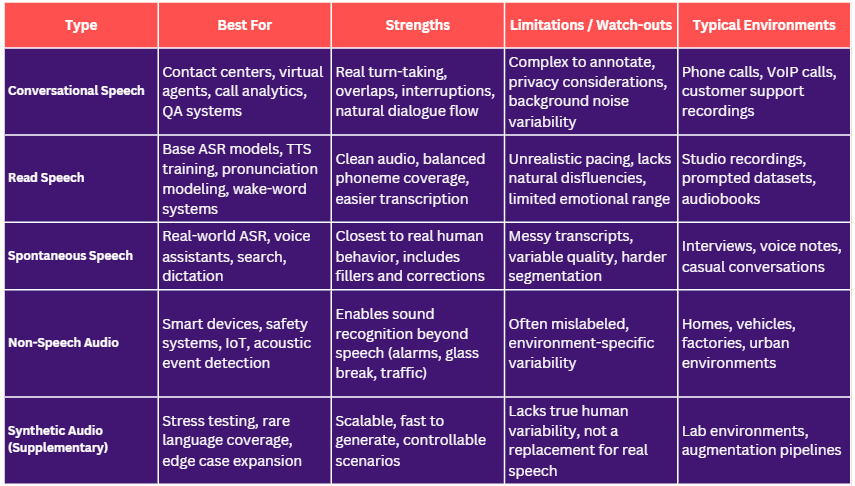
Our default stance at Andovar is simple: start with the mix that matches your real users and environments, then tap into multilingual voice data collection services and custom speech data to fill the gaps that generic corpora can’t cover.

Speech data spectrum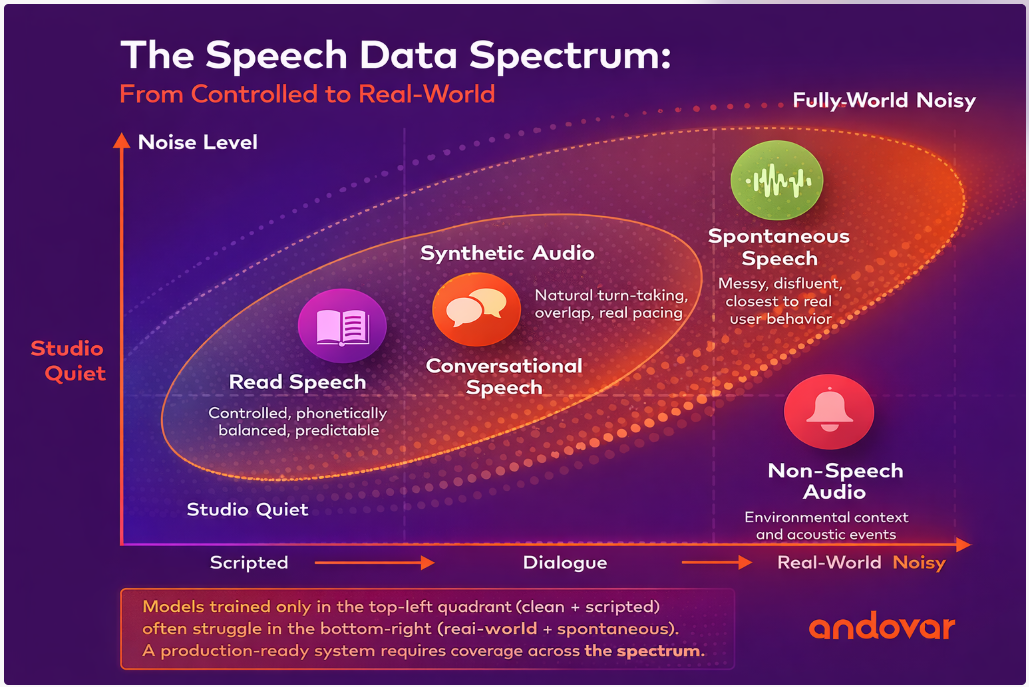
Want a deep dive into each data type? See our full article on the types of speech and audio data for AI.
Chapter 2
How is speech and audio data used in real‑world AI?
Speech and audio datasets quietly sit underneath most of the voice experiences we now take for granted—virtual assistants, live captions, call‑center analytics, in‑car controls, and more. When these datasets are diverse and well‑designed, models can handle different accents, languages, and noisy environments; when they’re narrow or noisy, you get misrecognitions, biased performance, and frustrated users.
Most overviews of speech data applications in AI agree on four big buckets:
- Automatic speech recognition (ASR) – Converting speech to text for assistants, transcription, and voice search.
- Voice‑driven NLP – Intent detection, sentiment analysis, and entity extraction for smarter bots and analytics.
- Voice biometrics and authentication – Using voice patterns to verify users in banking and secure apps.
- Industry‑specific tools – Contact‑center speech analytics, in‑car voice control, clinical dictation, language learning, and more.
Speech AI Use Cases & Data Requirements
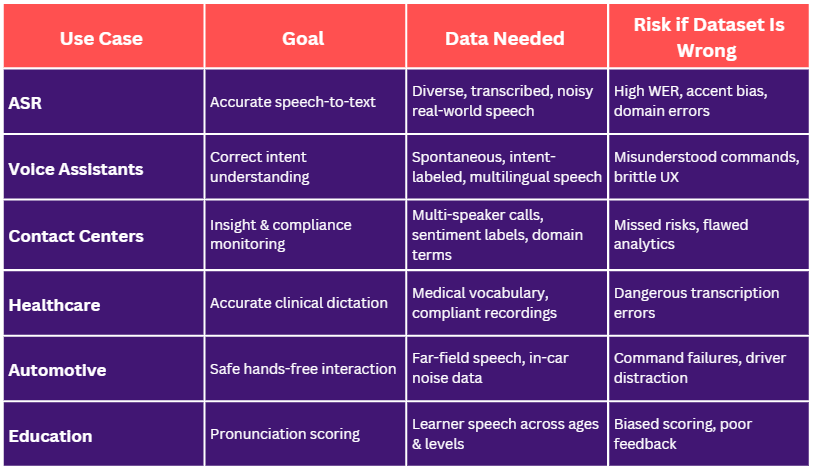
From our side at Andovar, we’re usually helping clients in three big ways: designing multilingual ASR training sets, feeding voice‑driven NLP systems with better labeled speech data, and collecting ethical, consent‑based custom speech data in finance, healthcare, customer service, and emerging markets.
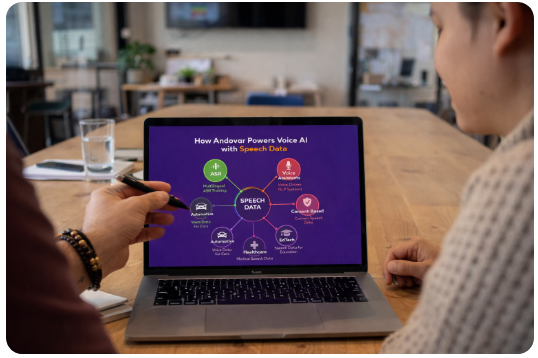
For real‑world examples and industry‑specific use cases, see our full article on how speech and audio data is used in AI
Chapter 3
What are the biggest challenges in working with audio datasets?
Once you get past the hype, building good speech and audio datasets is mostly about wrestling with a few stubborn problems: noisy recordings, biased coverage, annotation headaches, and the sheer logistics of doing this across languages and regions. Industry guides call outthe same recurring issues we see at Andovar: poor audio quality, limited accent and language diversity, inconsistent labels, and ethical or privacy concerns when voice data is collected without clear consent.
In our projects, the main headaches usually fall into five buckets:
- Bias and under‑representation – Over‑indexing on certain accents, demographics, or “clean” speakers leads to models that perform significantly worse on others.
- Poor audio quality – Background noise, cheap microphones, and crosstalk make it difficult for models to separate signal from noise.
- Scalability and logistics – Coordinating thousands of hours of recording, contributors, and QA across languages is non‑trivial.
- Annotation inconsistencies – Different annotators interpreting the same audio differently quietly erodes model performance.
- Ethics, privacy, and provenance – Unclear consent or licensing can turn a “free” dataset into a long‑term risk.
Key challenges in audio datasets
![[Table] “Key challenges in audio datasets” Add a simple table here with columns: Challenge / What it looks like / Why it hurts models. Fill rows for bias, low quality, scalability, inconsistent annotation, and unclear provenance, using brief phrases inspired by external summaries of audio‑dataset pitfalls.](https://blog.andovar.com/hs-fs/hubfs/image-png-Feb-17-2026-08-46-02-6005-AM.png?width=739&height=469&name=image-png-Feb-17-2026-08-46-02-6005-AM.png)
For examples, mitigation strategies, and how we approach these challenges at scale, see our article on the core challenges in working with audio datasets (and how to solve them).
Chapter 4
Why does metadata matter so much for speech data?
Raw audio is expensive to collect—but without metadata,even the best recordings turn into a messy archive you can’t search, audit, or safely reuse. Metadata is the “data about your data”: everything from speaker age and accent to recording environment, device, file format, licensing, and consent status. As one detailed overview of speech‑data metadata puts it, well‑designed metadata is what turns large audio collections from “unsearchable black boxes”into assets you can filter, split, and scale across many ML tasks.
For speech and audio datasets, four types of metadata do most of the heavy lifting:
- Descriptive metadata – Who is speaking and what they’re talking about (age, gender, language, accent, topic).
- Technical metadata – How the audio was captured (sample rate, bit rate, device, environment).
- Administrative metadata – Rights, consent, licensing terms, creation dates.
- Structural metadata – How files and segments relate (speaker turns, timestamps, links between audio and transcripts).
Types of metadata for speech datasets![[Table] – “Types of metadata for speech datasets” Simple 3‑column table: Type / Examples / Why it matters. Use examples like “speaker age, accent”, “recording environment, device type”, “usage rights, licence ID”, “segment timestamps, file relationships”, consistent with third‑party explanations of audio metadata schemas.](https://blog.andovar.com/hs-fs/hubfs/image-png-Feb-17-2026-08-31-17-7496-AM.png?width=976&height=610&name=image-png-Feb-17-2026-08-31-17-7496-AM.png)

Metadata as invisible infrastructure
![[Infographic] – “Metadata as invisible infrastructure” A simple layered diagram: Audio at the bottom, Metadata layer in the middle (descriptive, technical, administrative, structural), Models at the top. Text label: “Metadata is what makes speech data searchable, auditable and reusable.”](https://blog.andovar.com/hs-fs/hubfs/Metadata%20as%20invisible%20infrastructure.png?width=493&height=736&name=Metadata%20as%20invisible%20infrastructure.png)
At Andovar, we design our multilingual voice data collection services and custom speech data projects with metadata in mind from day one—so you can filter by speaker group, environment, or licence terms, not just file names.
For examples, best practices, and how we structure metadata in real projects, see our deep‑dive on metadata for speech data.
Chapter 5
Ethics & privacy
How do you collect speech data ethically and protect privacy?
Voice is inherently personal: it can reveal identity, accent, emotional state, and sometimes health or biometric traits. Recent articles on speech‑data ethics stress that ethical collection rests on fourpillars: informed consent, transparency, fairness, and accountability. In practice, that means participants know what’s being recorded, why, how it will be used, and what their rights are—and you can prove it later if regulators or customers ask.
From both industry guidance and our own projects at Andovar, responsible speech data practices revolve around a few key points:
- Informed consent – Clear, opt‑in explanations of what’s collected, how it’s used, and how to withdraw.
- Transparency and data minimisation – Only collect what you need; be open about processing and retention.
- Security and privacy‑by‑design – Encrypt recordings, control access, and plan deletion from the start.
- Fairness and non‑exploitation – Fair compensation, no targeting vulnerable groups, and balanced datasets so models don’t systematically fail on specific populations.
Key ethical pillars for speech data
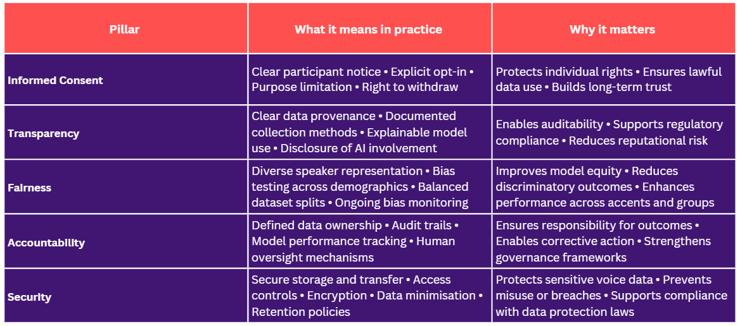
Ethical speech data funnel
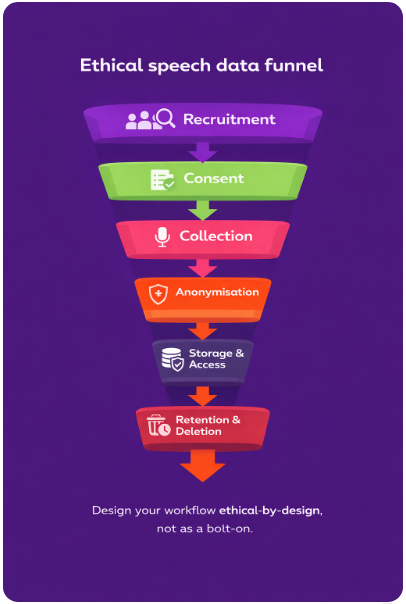
We embed these principles into our multilingual voice data collection services and custom speech data projects so you can confidently say your datasets are consent‑based, licensed, and future‑proof.
For frameworks, practical checklists, and how we implement ethical speech data in real projects, see our full article on ethical and privacy concerns in voice data collection.
Chapter 6
Annotation
How do you annotate speech and audio data the right way?
Annotation is where raw audio turns into training signal. Good speech annotation is more than just transcription; it often includes time stamps, speaker turns, language tags, entities, intents, acoustic events, and sometimes sentiment. Guides on audio data labeling make the same point we see in our projects at Andovar: the quality and consistency of these labels directly determines how accurate and robust your ASR and voice‑driven systems can become.
The main challenges tend to fall into a few buckets:
- Complexity of audio – Overlapping speech, accents, noise, and disfluencies.
- Inconsistent guidelines – Different annotators making different choices for the same audio.
- Scale and fatigue – Long files and repetitive tasks leading to errors over time.
- Deciding what to automate – When to use ASR pre‑labels vs full human transcription.
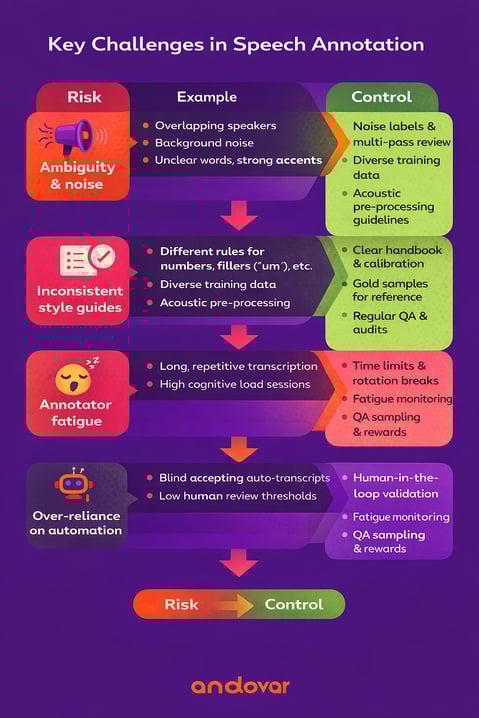
At Andovar, we combine pre‑labeling, clear annotation guidelines, and our multilingual data annotation services to keep labels consistent across languages and projects, while preserving the nuance that makes speech data so valuable.
For best practices, workflows, and real‑world tips, see our article on: voice, speech, and audio annotation for AI.
Chapter 7
Building better audio datasets
How do you build better audio datasets in practice?
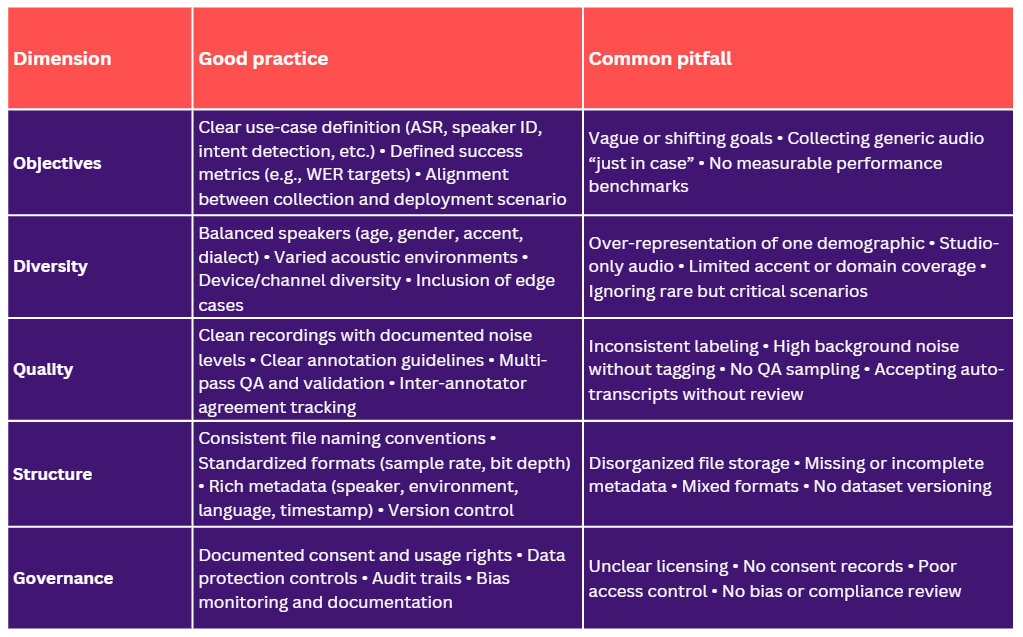
“Better” audio datasets aren’t just bigger—they’re more aligned, diverse, clean, and well‑governed. Guides on audio datasets and multilingual corpora stress the same themes: define clear objectives, design for diversity, enforce quality standards, and treat governance (metadata, rights, and security) as part of the build, not an afterthought.
From what we see at Andovar, strong speech datasets usually share five traits:
- Clear objectives – You know which use cases, languages, and environments you’re designing for, instead of collecting “whatever’s easy.”
- Diversity by design – You deliberately cover key accents, languages, age groups, and acoustic conditions.
- Quality over quantity – Clean, consistent recordings and labels beat sheer hours of noisy, misaligned audio.
- Thoughtful preprocessing and structure – Consistent formats, segmentation, and metadata schemas make the dataset reusable.
- Governance and ethics baked in – Consent, licensing, and security are built into your process.
Andovar's e-commerce dataset (90k+ samples) nailed all five traits—targeted shopping intents, diverse accents/noise, top-tier QA. Delivered 93% accuracy and 18% conversion lift.

Data‑centric audio pipeline
At Andovar, we bring this together through our multilingual voice data collection services, custom speech data projects, and multilingual data annotation services, so your dataset strategy matches your product and regulatory reality.
For a step‑by‑step approach and concrete examples, read our article on solutions to build better audio datasets.
Chapter 8
The future of speech training data
What’s the future of training data for speech recognition?
Speech AI is getting more “data‑centric.” Instead of obsessing only over model architectures, more teams are focusing on how they collect, curate, and document speech data. Recent work on data‑centric speech pre‑training and large multilingual corpora shows that carefully selected, well‑balanced datasets can match or beat much larger, more expensive collections—especially when they better reflect real users.
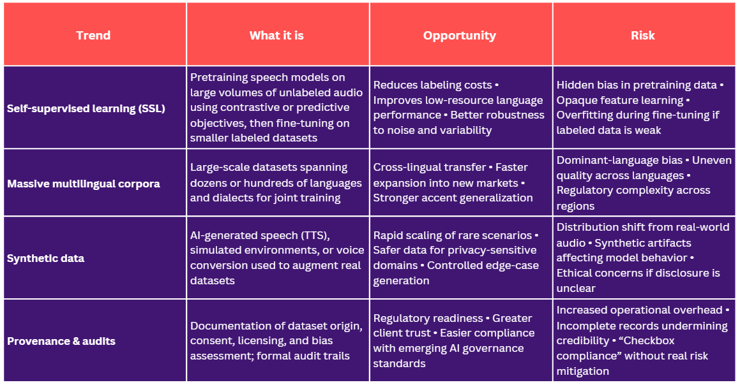
Looking ahead, a few trends stand out:
- Massive multilingual corpora + self‑supervised learning – Huge unlabeled datasets like Unsupervised People’s Speech (1M+ hours, dozens of languages) are being used to pre‑train powerful speech models before small task‑specific fine‑tuning.
- Synthetic data and augmentation – Synthetic speech and audio are increasingly used to expand datasets and cover edge cases, but external research warns they must be used carefully to avoid distribution shift and authenticity issues.
- Data provenance and audits – Papers auditing hundreds of speech datasets now emphasise traceable sources, licences, and demographic coverage, reflecting a clear push toward dataset transparency and provenance.
Emerging trends in speech training data
For Andovar, this future reinforces what we’re already doing: building custom, traceable, multilingual speech data that works alongside large public datasets and self‑supervised models, and giving clients the provenance trail they’ll need as scrutiny over training data increases.
For a closer look at these trends and what they mean in practice, read our article on the future of training data for speech recognition.
Chapter 9
Off‑the‑shelf vs Custom Datasets
Why isn’t off‑the‑shelf speech data enough on its own?
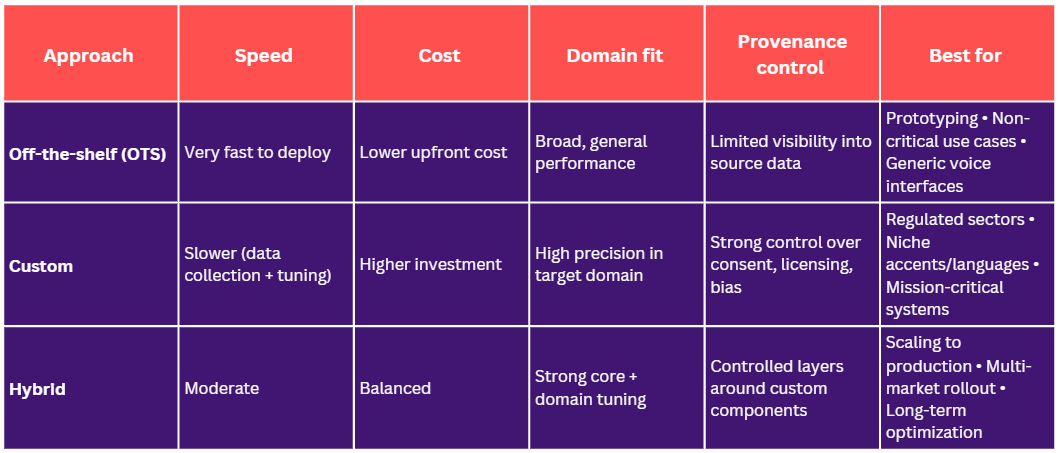
Off‑the‑shelf (OTS) speech datasets are great for getting started: they’re ready‑made, relatively affordable, and let you prototype quickly. But they’re also generic by design. Articles comparing OTS vs custom datasets point out the same trade‑off we see at Andovar: OTS datasets win on speed and cost, while custom collection swin on relevance, control, and long‑term performance.
In practice, this means:
- OTS corpora are ideal for broad, general‑purpose models and early experimentation.
- Custom speech data is crucial when domain terminology, local accents, regulatory demands, or high‑stakes decisions mean you need tight alignment between data and real users.
- The best results usually come from a hybrid strategy: use OTS for a foundation, then add targeted custom data to close the gaps that matter for your products.
Andovar's banking hybrid: OTS foundation + 40k custom samples hit 97% accuracy (vs. 85% OTS-only), blending speed with domain relevance for fraud-proof voice security.

Off‑the‑shelf vs custom vs hybrid
At Andovar, we lean into that hybrid model: we help you combine off‑the‑shelf datasets with custom speech data and multilingual voice data collection services, so you get both speed and precision—and a clear provenance story for the parts that matter most.
For a deeper comparison and examples, see our full article on why off‑the‑shelf speech data alone isn’t enough.
Chapter 10
Industry snapshots & next steps
Where is speech data creating the most value right now?
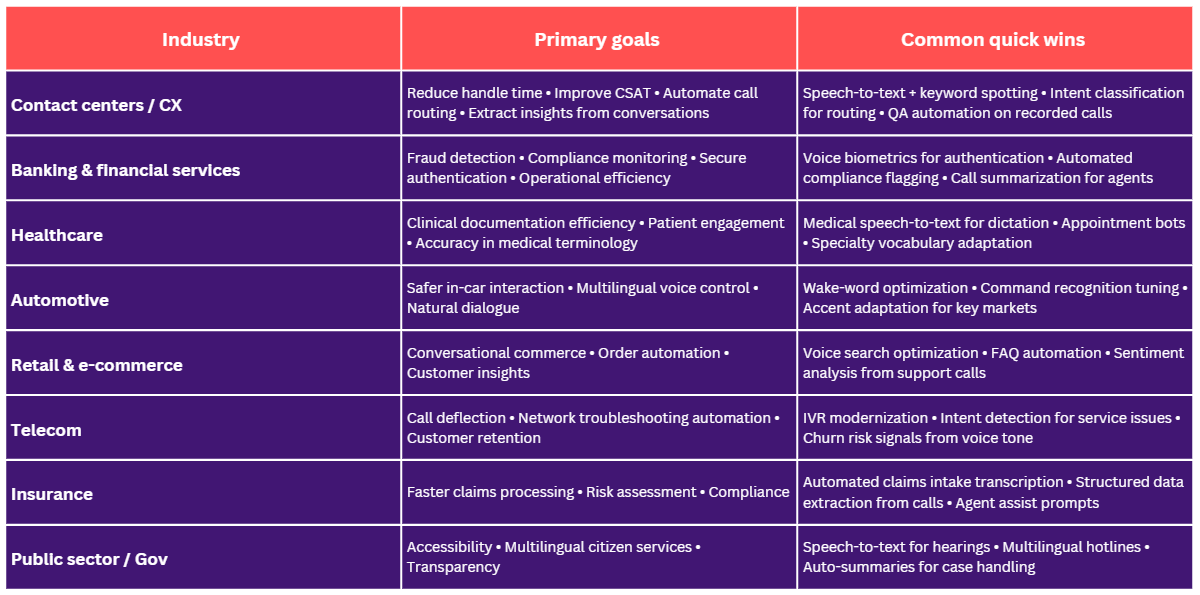
Across industries, the same pattern is emerging: teams that treat speech data as a strategic asset are using it to cut costs, improve service quality, and unlock new products. Practical guides point to a few front‑runner sectors:
- Contact centers & customer support – Using speech analytics to improve CSAT, coach agents, detect churn risk, and monitor compliance.
- Banking & financial services – Combining speech analytics with voice authentication for fraud detection, compliance, and better customer journeys.
- Healthcare – Applying Voice AI to clinical documentation, telehealth triage, adherence support, and patient engagement.
- Automotive & mobility – In‑car voice assistants for hands‑free control, navigation, and safety, plus dealership voice agents for lead handling.
Speech data by industry: goals & quick wins
Our final chapter pulls this together into concrete industry examples and an action checklist so you can decide where to start with speech data in your own organisation.
Bringing It All Together
Your Speech Data Action Plan
If there’s one theme that runs through this playbook, it’s that better speech data beats bigger models. High‑performing voice systems aren’t built on ad‑hoc recordings and mystery corpora; they’re built on deliberately designed datasets that match your users, your domains, and your regulatory reality.
Across the chapters you’ve seen how the pieces fit:
- Chapters 1–2 showed why data types and applications matter: conversational vs read vs spontaneous speech, non‑speech audio, and the core use cases where speech data creates value.
- Chapters 3–4 tackled challenges and metadata: bias, quality, scale, and the metadata you need to keep datasets searchable, auditable, and reusable.
- Chapters 5–6 focused on ethics and annotation: informed consent, privacy, fairness, and the labeling practices that actually improve models.
- Chapters 7–8 looked ahead: how to build better audio datasets and how the future of speech training data is becoming data‑centric, multilingual, and provenance‑driven.
- Chapter 9–10 turned this into strategy and action: hybrid off‑the‑shelf + custom approaches, industry snapshots, and a simple checklist to plan your next steps.
From here, you have two paths:
- Use this playbook as an internal blueprint to assess your current datasets, identify gaps, and prioritise where custom speech data, better annotation, or new governance is most urgent.
- Or, if you’d like a partner, talk to us about scoping multilingual voice data collection, custom speech data projects, and multilingual data annotation services tailored to your markets and use cases.
Either way, the organisations that win with voice over the next few years will be the ones that treat speech data as infrastructure—not an afterthought. This pillar is designed to help you make that shift, one chapterand one project at a time.

FAQ: Speech Data Strategy Essentials
What exactly is a speech data strategy?
A speech data strategy is your roadmap for sourcing, curating, and governing audio datasets to power reliable voice AI—focusing on accents, noise, domains like contact centers, and ethics to avoid bias. Andovar's expertise turns this into actionable playbooks; try our custom speech data services for tailored strategies.
Why prioritize ethical data in speech AI projects?
Ethical data ensures consent, fairness, and privacy-by-design, dodging GDPR fines and bias failures in banking or healthcare. Andovar leads with proven ethical workflows—contact us to build compliant datasets that build trust.
How does speech data quality affect AI outcomes?
Top-tier speech data cuts word error rates 20-40% in real-world accents/noise, powering robust ASR and NLP. Andovar's high-quality collections deliver these gains; explore off-the-shelf or custom options to elevate your voice AI.
What's the best speech data strategy: off-the-shelf or custom?
Hybrid wins—off-the-shelf for speed, custom for relevance—hitting 97% accuracy as in Andovar's fintech projects. Discover the right mix with our expertise: start with custom speech data.
What are top speech data challenges and solutions?
Bias, noise, annotation drift, scalability—solved via diversity-by-design, QA, and governance, as Andovar achieves 92%+ accuracy in automotive cases. Let our global studios handle it: request a dataset review.
How to launch an ethical speech data strategy today?
Define goals, secure consents, diversify with metadata, and audit provenance—Andovar makes it seamless and scalable for 2026 regs. Partner with us now for end-to-end ethical speech data solutions.
About the Author: Steven Bussey
A Fusion of Expertise and Passion: Born and raised in the UK, Steven has spent the past 24 years immersing himself in the vibrant culture of Bangkok. As a marketing specialist with a focus on language services, translation, localization, and multilingual AI data training, Steven brings a unique blend of skills and insights to the table. His expertise extends to marketing tech stacks, digital marketing strategy, and email marketing, positioning him as a versatile and forward-thinking professional in his field....More