





Introduction
Ask ten people where speech and audio data matters in AI and they'll say "Siri, Alexa, and call-center bots"—which is true, but barely scratches the surface. The same speech data powering your virtual assistant also drives live captioning, contact-center analytics ($4.01B market in 2026, 15.27% CAGR), fraud detection, and even parts of LLM pipelines that ingest transcribed audio.
At Andovar, we see the same pattern in finance, customer service, automotive, healthcare, and consumer tech: the teams who invest in the right datasets end up with voice systems that feel natural and reliable; the teams who wing it with whatever audio is handy often get stuck in a loop of patches and hot-fixes. In this article, we'll walk through the main ways speech and audio datasets are used today, with examples and practical takeaways you can apply to your own roadmap.
This article is part of our wider speech data strategy playbook, where we cover data types, ethics, hybrid strategies, and more..png?width=2240&height=1260&name=How%20Speech%20and%20Audio%20Data%20Is%20Used%20in%20AI%20(With%20Real%E2%80%90World%20Use%20Cases).png)
Example speech data applications by industry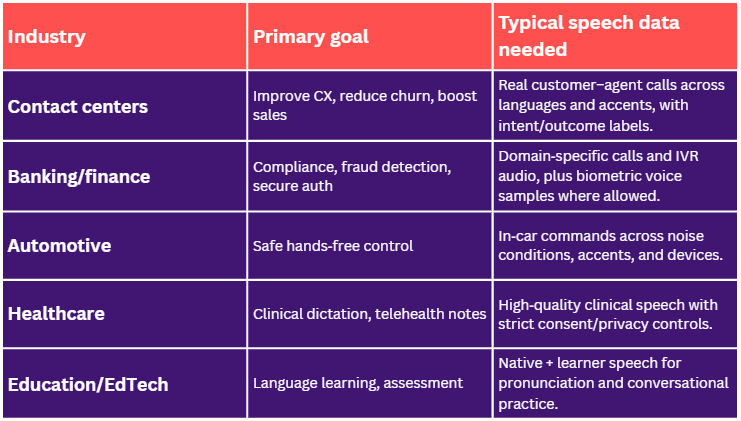
How does speech data power core AI capabilities?
ASR: turning talk into text
Automatic speech recognition (ASR) is the obvious one: converting spoken language into text for assistants, dictation tools, and search. Guides on audio datasets emphasise that ASR models only perform well across accents and noise conditions when trained on diverse, well‑annotated speech data.
From our perspective, ASR datasets usually need:
- Multilingual coverage and regional accents where you operate.
- Both clean and noisy recordings (studios, homes, cars, call centers).
- Accurate transcripts and metadata so you can audit performance by group.
We typically blend existing off‑the‑shelf corpora with custom speech data tailored to specific domains like banking, insurance, or tech support.
Voice‑driven NLP: understanding what people really mean
Once you have text, you still need to understand it. Voice‑driven NLP uses transcripts (and sometimes prosodic cues) to detect intent, sentiment, topics, and entities, powering chatbots, voice bots, and analytics platforms.
That requires:
- Speech datasets that reflect the kinds of questions and complaints your users actually voice.
- Labels for intents, outcomes, and sometimes sentiment so models can learn beyond raw words.
This is where we combine our multilingual voice data collection services with multilingual data annotation services—so you get both the audio and the structured labels you need.
![[Infographic] Funnel showing: Raw audio → ASR → NLP (intent/sentiment) → Analytics dashboard, labelled with “speech data + annotation” at the input.](https://blog.andovar.com/hs-fs/hubfs/Speech%20Intelligence%20Funnel.png?width=565&height=841&name=Speech%20Intelligence%20Funnel.png)
Want your voice use case mapped to the right data?
We’ve helped teams in banking, healthcare, contact centers, and consumer devices scope the datasets they actually need for ASR, voicebots, and analytics. If you’d like a sanity check on your speech data plan, we can walk through it with you.

What does speech data look like in different industries?
Contact centers: CX, compliance, and revenue
Contact‑center speech analytics is a classic example: you record calls, transcribe them, then use NLP to find patterns in what customer say and how they feel. Case studies in this space regularly show big uplifts when teams use high‑quality, domain‑specific speech data for training—think double‑digit improvements in conversion or drops in complaint volumes once issues are detected and fixed.
A strong contact‑center dataset usually includes:
- Thousands of real customer–agent calls across products, regions, and channels.
- Good balance of languages and accents, matching your customer base.
- Labels for intents (cancellations, complaints, upgrades), outcomes, and sometimes sentiment.
That’s exactly the kind of custom speech data project we run for clients who want to move beyond generic English‑only models.
Finance and banking: security and precision
Banks use speech data both for ASR/NLP in contact centers and for voice biometrics in authentication flows. Here, accuracy and compliance matter more than almost anywhere else.
We often help by:
- Collecting domain‑specific voice data with realistic disclosures and domain language.
- Annotating calls for compliance phrases, risky statements, and outcomes.
- Ensuring the data is consent‑based and properly licensed, to align with regulatory expectations.
Automotive: in‑car voice control
Cars are noisy: engines, roads, passengers, music. Audio data from in‑car environments is crucial for robust voice commands and assistants. Multilingual audio datasets that capture these conditions help assistants understand navigation requests, media commands, and calls across accents and noise levels.
We extend that with custom voice data projects that record speakers in real vehicles, across markets, with the prompts and languages that matter for a given OEM.
Healthcare and education
- Healthcare – Clinical dictation, telehealth notes, and early work on vocal biomarkers all need tightly controlled, privacy‑sensitive speech data.
- EdTech – Language‑learning apps rely on both native and learner voice data for pronunciation feedback and conversational training.
These sectors are where ethical sourcing and consent become especially central.
How do multilingual and low‑resource use cases change the picture?
Guides to multilingual audio datasets highlight that if your product is global, you can’t treat English as the default and everything else as an afterthought. Multilingual and low‑resource speech datasets are the difference between “works fine in one market” and “works for everyone.”
In practical terms, that means:
- Collecting multilingual speech data across target markets, not just translating text.
- Capturing regional accents and dialects, which multilingual dataset guides emphasise as critical for real global usability.
- Combining larger public corpora (like multilingual audiobook‑style sets) with custom speech data for under‑served languages and domains.
This is an area where our global contributor network and experience with low‑resource languages come into play.
Need speech data across multiple languages and regions?
We can source native speakers, design prompts, and collect labelled audio in both major and low‑resource languages—backed by clear consent and licensing.

How does Andovar map applications to concrete datasets?
When we scope a project, we usually walk clients through three questions:
ASR, voicebot, analytics, biometrics, education, etc.
Which markets and languages matter most?
And what accents and demographics within those markets?
What’s your risk profile?
How sensitive is the content? What regulatory regimes apply?
Then we design a plan that combines:
- Suitable off‑the‑shelf speech datasets (where provenance and licensing are clear).
- Targeted custom speech data collection for your core use cases and markets.
- Annotation and metadata through our multilingual data annotation services, so you can slice results and maintain provenance over time.
This mirrors what third‑party audio data guides recommend: start with your application and coverage needs, then select or build datasets that match, rather than grabbing whatever is convenient.
Andovar Use Case
Andovar partnered with a leading European fintech firm to create a multilingual speech dataset powering a secure voice authentication and customer analytics system. Covering 10 languages including English, German, French, and Eastern European dialects, the project delivered 75,000+ audio samples tailored for production deployment in mobile banking apps and call centers.
Applications Applied
- Automatic Speech Recognition (ASR, 40%): Read and spontaneous speech for converting queries like "transfer 500 euros to savings" into accurate text, even in noisy public spaces or with regional accents.
- Voice-driven NLP (30%): Conversational dialogues annotated for intent (e.g., "fraud alert"), sentiment (frustrated vs. neutral), and entities (account numbers), enabling smarter chatbots that route issues proactively.
- Voice biometrics (20%): Spontaneous passphrase recordings from diverse demographics to train speaker verification models, capturing unique vocal traits like pitch variation and formants for fraud-proof authentication.
- Industry-specific (10%): Contact center analytics with environmental audio (background call noise) for real-time quality scoring and compliance monitoring.
Results and Impact
The platform achieved 95% authentication accuracy across accents (up from 82%), reduced false positives by 32%, and cut analytics processing time by 45%—all while meeting GDPR and eIDAS standards through ethical sourcing. Users reported 25% higher satisfaction in multilingual regions.
FAQ
Q1. What are the most common AI applications of speech datatoday?
The big ones are automatic speech recognition (ASR) for assistants and transcription, voice‑driven NLP for bots and analytics, and voice biometrics for authentication, plus industry‑specific tools in contact centers, automotive, healthcare, and education.
Q2. Do I need different datasets for ASR and for analytics?
Often yes. ASR training focuses on accurate transcripts across accents and conditions, while analytics and voicebots need additional labels for intents, topics, and sentiment. In practice, many teams share raw speech data but use richer annotation for down stream NLP tasks.
Q3. Can I use English‑only datasets and just translate outputs for other markets?
You can prototype that way, but you’ll quickly see accuracy drop for other languages and accents. Multilingual dataset guides emphasise that models need speech data from each target language and dialect to perform reliably.
Q4. How much real‑world audio do I need for a first deployment?
It depends on your use case and languages, but high‑quality, domain‑matched recordings are often more important than raw hours. Many successful systems start with a mix of off‑the‑shelf corpora and dozens to hundreds of hours of custom speech data in the core use cases, then expand based on measured gaps.
Q5. How can Andovar help if I already have some data?
We can audit your existing speech datasets, identify coverage gaps, and design custom speech data and multilingual data annotation projectsto fill them. That way, you’re not starting from scratch—you’re upgrading and aligning what you already have.
Check out our speech data strategy playbook, where we cover data types, ethics, hybrid strategies, and more.
Additional 3rd party resources:
A complete guide to audio datasets

About the Author: Steven Bussey
A Fusion of Expertise and Passion: Born and raised in the UK, Steven has spent the past 24 years immersing himself in the vibrant culture of Bangkok. As a marketing specialist with a focus on language services, translation, localization, and multilingual AI data training, Steven brings a unique blend of skills and insights to the table. His expertise extends to marketing tech stacks, digital marketing strategy, and email marketing, positioning him as a versatile and forward-thinking professional in his field....More