






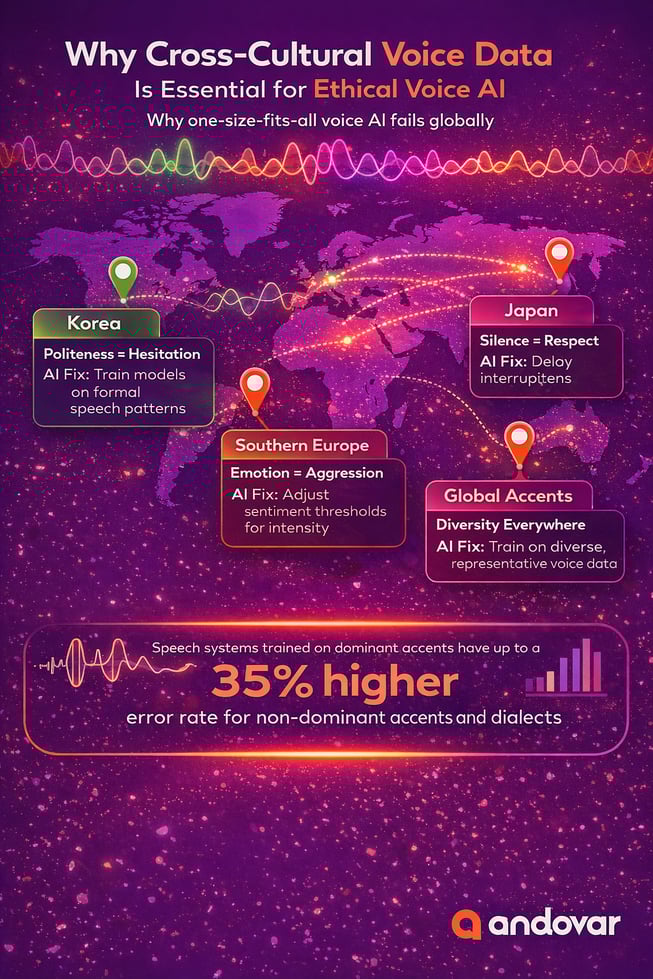
A global company rolls out a voice assistant across five regions using what it believes is robust Ethical Data and high-quality Voice Data. On paper, every thing looks solid. The same language, the same scripts, the same AI model but within weeks, customer complaints start piling up. The system keeps interrupting users in Japan. It misreads politeness in Korea as hesitation. It flags emotional speech in Southern Europe as aggression.
What failed was something far more fundamental. The system assumed speech worked the same everywhere. It didn’t. This is where ethical voice data comes into play. As multilingual speech data becomes deeply embedded in finance, automotive, healthcare and customer experience, ignoring cultural nuance is no longer a UX issue. It is an ethical one.
This article is part of our speech data strategy playbook—you can always jump back to the main overview for the full picture.
Here we explore why cross-cultural voice data matters, how ignoring it introduces bias and what ethical data localization really looks like in practice.

Speech Is Cultural, Not Universal- The Foundation of Ethical Voice Data
Speech is shaped by culture long before it becomes Voice Data. How people pause, show respect, express emotion or signal agreement varies dramatically across regions. These differences exist even within the same language.
Research across academia consistently shows that speech AI trained on dominant demographic Voice Data performs significantly worse for underrepresented accents and cultures. That gap is not accidental. It is baked into the data.
When datasets assume a “neutral” or “standard” way of speaking, they silently privilege one group over others. Ethical voice data practices reject the myth of culturally neutral speech.
Examples of Cross-Cultural Differences in Voice Data
Pauses and Silence in Cross-Cultural Voice Data
In many Western cultures, silence during conversation can feel awkward or signal disengagement. In Japan, Finland and several Indigenous cultures, silence often signals respect or careful thought.
Voice AI systems trained without culturally grounded Ethical Data and representative Voice Data may interpret silence as confusion or failure. This leads to premature interruptions, incorrect intent detection and unfair scoring in call analytics. From an ethical standpoint, penalizing culturally normal behavior because of gaps in Ethical Data is a clear form of bias.
Politeness Markers in Multilingual Speech Data
Politeness is not just a tone choice. In languages such as Japanese, Korean, and Thai, politeness is structurally embedded in grammar and vocabulary. Ignoring these markers strips speech of its intended meaning.
Many top-performing blogs on multilingual AI highlight that models trained without localized politeness cues often misclassify respectful indirect speech as uncertainty. Ethical data localization ensures these linguistic signals are preserved rather than flattened.
Emotional Expression and Accent-Driven Bias
Emotional expression varies widely across cultures:
- Some cultures communicate emotion through strong intonation
- Some normalize loud speech in everyday conversation
- Others rely on subtle cues
Voice AI trained on narrow emotional ranges may mislabel speakers from other cultures as aggressive, distressed or disengaged.
Emotion recognition systems trained primarily on Western data sets misinterpret non-Western emotional cues at significantly higher rates. This directly affects applications in healthcare, mental health and customer experience.
Why Ignoring Nuance Is Unethical in Accent and Dialect AI
Cultural Misrepresentation in Voice Datasets
When voice datasets overrepresent certain accents, they define those accents as “normal.” Others become statistical outliers. This leads to:
- Dialects labelled as low quality
- Reduced accuracy for minority speakers
- Cultural erasure disguised as optimization
Ethical Voice Data requires intentional representation, not accidental dominance.
AI Misunderstanding Users at Scale
According to Accenture’s AI trust research, over 60% of users lose confidence in AI systems after repeated misunderstandings, especially in voice interfaces.
When those misunderstandings disproportionately affect certain cultural groups, the system becomes inequitable. Ethical voice data is about preventing that imbalance before deployment, not apologizing for it afterwards.
Ethical Voice Data Collection Strategies That Work
Regional Prompt Localization for Ethical Data Localization
Generic prompts produce unnatural speech. Ethical voice data collection requires prompts that reflect local contexts, conversational norms and real-world scenarios. Localized prompts improve data authenticity and reduce contributor fatigue. This approach is foundational to responsible ethical data localization and is central to high-quality voice data sets.
Native Reviewer Involvement in Cross-Cultural Voice Data
Automation alone cannot validate cultural nuance. Native reviewers understand when speech sounds natural, respectful and contextually correct.
Human-in-the-loop review is repeatedly cited by top industry blogs as the most effective way to reduce bias in multilingual datasets. It ensures that intent and meaning are preserved, not just transcribed.
Dialect-Level Sampling for Accent and Dialect AI
Languages are families, not single entities. Ethical voice data requires deliberate sampling across dialects, regions and sociolects.
This is especially important in accent and dialect AI, where acceptable overall accuracy can hide severe performance gaps for specific groups. Dialect-level sampling surfaces those gaps early.
| Cultural Factor | Example Region | AI Misinterpretation Risk | Ethical Data Solution |
| Silence & Pauses | Japan, Finland | Assumed confusion | Train on local conversational timing |
| Indirect Politeness | Korea, Japan | Classified as uncertainty | Preserve politeness markers |
| Expressive Speech | Southern Europe | Flagged as aggression | Include emotional diversity |
| Accent Variation | Global | Higher error rates | Dialect-level Voice Data |
| Code-Switching | Multilingual regions | Intent detection failure | Multilingual Ethical Datasets |

Use Cases Where Ethical Voice Data Is Mission-Critical
Banking and Financial Services
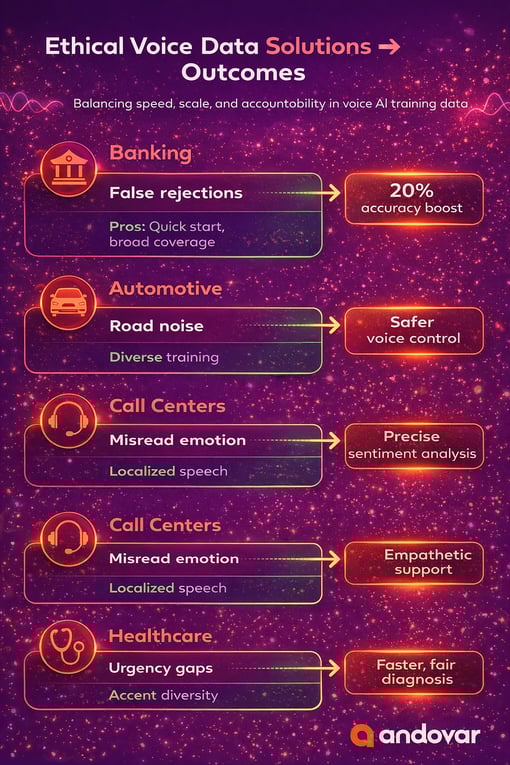
Voice authentication systems often show higher false rejection rates for non-dominant accents, creating friction and exclusion in high-stakes environments such as banking and payments.
These failures undermine user trust and can disproportionately impact already marginalized groups. Ethically sourced, accent-aware(Voice Data) datasets help models better reflect real-world speech diversity, improving accuracy, fairness and user experience.
In financial applications, this also supports regulatory compliance by reducing bias, strengthening auditability and demonstrating responsible AI deployment.
Automotive Voice Assistants
On the road, voice assistants don’t get the luxury of quiet rooms or uniform accents. In vehicles, systems must perform amid engine noise, traffic and multilingual passengers. Models trained on narrow, controlled datasets often fail in these real-world conditions, leading to frustration or unsafe distractions.
Ethical voice data—diverse, contextual and responsibly sourced—improves recognition accuracy, usability and safety; while enabling automotive platforms to scale confidently across regions, languages and markets.
Call Centers and Customer Experience Platforms
A raised voice doesn’t always signal anger and a pause doesn’t always mean uncertainty. Emotion and intent detection models often misread culturally different speech patterns, leading to incorrect sentiment scoring and misguided agent responses. These errors frustrate customers and reduce operational effectiveness. Localized, ethically sourced voice data sets capture cultural context more accurately.
Helping systems interpret intent with greater precision, improve agent guidance and ultimately deliver more empathetic, efficient customer experiences.
Healthcare and Digital Health Applications
Cultural differences in describing pain or urgency can affect diagnosis and triage. Voice AI systems must reflect these differences to avoid bias in care delivery. Ethical voice data supports more equitable healthcare outcomes.
Off-the-Shelf Data vs Custom Data: A Reality Check
Off-the-shelf datasets help teams hit the ground running. They are useful for prototyping and baseline training.
However, many top-ranking blogs on AI ethics point out that OTS datasets often lack clear consent trails, dialect depth and cultural documentation. This creates long-term risk.
| Data Type | Advantages | Ethical Risks | Best Use |
| Off-the-Shelf Data | Fast, scalable | Limited transparency | Prototyping |
| Crowdsourced Data | Diverse | Variable quality | Early training |
| Custom Ethical Data | High relevance | Higher cost | Production systems |
From an industry perspective, the most practical approach is a mixed model:
- Baseline crowdsourced or OTS data
- Optimized with ethically sourced custom data
Custom data provides clarity around provenance, consent and compliance. As regulation tightens, that clarity will matter.
Ethical Voice Data and the Future of Regulation
Global AI regulation is shifting toward transparency and accountability. The OECD AI Principles emphasize traceability and responsible data sourcing.
Companies will increasingly be asked a simple question:
Can you prove where your training data came from?
With opaque datasets, that answer is uncertain. With ethically sourced custom data, it is clear.

Key Statistics Supporting Ethical Voice Data
- Speech systems trained on the majority accents show up to 35% higher error rates for minority dialects (Stanford AI research).
- 72% of enterprises expect AI regulations to require disclosure of training data sources within five years (Deloitte).
- Human-reviewed voice datasets reduce cultural misclassification errors by over 25% compared to automated pipelines (MIT Media Lab).
Impact of Ethical Voice Data Practices
| Area | Without Ethical Localization | With Ethical Localization |
| Accent Accuracy | Uneven | Consistently high |
| User Trust | Declines | Strengthens |
| Regulatory Risk | High | Reduced |
| Bias Detection | Limited | Proactive |
| Global Scalability | Fragile | Sustainable |

FAQs
Q1. Why does cross-cultural voice data matter?
Because speech reflects culture. Ignoring that reality leads to biased systems that fail real users.
Q2. What is ethical data localization in voice AI?
It means adapting data collection to local language, culture and communication norms.
Q3. Can synthetic data replace ethical voice data?
Synthetic data helps, but it depends entirely on the quality and ethics of the real data behind it.
Q4. How does accent bias affect voice AI systems?
Accent bias causes higher error rates for non-dominant speakers, reducing accuracy and trust.
Q5. Can off-the-shelf voice data be used ethically?
Yes, but only with caution. Many datasets lack transparency around consent and sourcing.
Final thoughts
In the rush to build faster, bigger and more impressive speech systems, it’s tempting to treat voice as just another data stream. But voice is never neutral.
It carries identity, culture, history and context often all at once. That’s why ethical voice data isn’t about chasing technical perfection or eliminating every edge case. It’s about making deliberate, responsible choices at every stage of development.
Speech AI that respects cultural nuance doesn’t just avoid harm; it performs better. It understands speakers more accurately, adapts to real-world diversity and feels more natural to the people who interact with it. That respect translates into trust—trust from users, partners and regulators alike. Trust is what determines whether a system scales beyond a controlled environment.
Ignoring nuance might pass a demo or boost short-term metrics. In the real world, it leads to misrecognition, exclusion and reputational risk.
As expectations rise and regulations evolve, responsibility is no longer optional; it’s foundational. Ethical voice data is ultimately along-term strategy. One that aligns technical excellence with human reality and ensures speech AI remains relevant, credible and sustainable.
- Speech is culturally embedded, not universal
- Ignoring nuance introduces ethical and technical bias
- Ethical voice data requires localization, native review and dialect coverage
- Mixed data models balance scale, cost, and accountability
- Data provenance will define the future of speech AI

About the Author: Steven Bussey
A Fusion of Expertise and Passion: Born and raised in the UK, Steven has spent the past 24 years immersing himself in the vibrant culture of Bangkok. As a marketing specialist with a focus on language services, translation, localization and multilingual AI data training, Steven brings a unique blend of skills and insights to the table. His expertise extends to marketing tech stacks, digital marketing strategy, and email marketing, positioning him as a versatile and forward-thinking professional in his field....More