





Introduction
Collecting speech data is not just a technical task; it's a trust exercise. A voice recording can identify a person, reveal their accent and region, hint at their emotional state, and sometimes expose health or financial details. Guidance on ethical speech data collection is clear: if you treat voice data as "just another file," you're walking into legal and reputational risk—like Amazon's $25M FTC fine for mishandling children's voice data under COPPA.
At Andovar, we build multilingual voice data collection and custom speech data projects around informed consent, transparency, fairness, and strong governance (amid 2026's stricter GDPR/HIPAA/TCPA rules), because we know clients will increasingly be asked: Where did this data come from? Do you have consent? Under what licence? In this article, we'll walk through the main ethical and privacy issues we see in voice data, the principles recognised in broader data-ethics discussions, and the specific safeguards we put in place.
This article is part of our wider speech data strategy playbook.

What are the core principles of ethical speech data collection?
5 common principles:
- Informed consent – People should know what’s being collected, why, and what happens to it.
- Transparency – Clear explanations of who you are, how long you keep data, and who you share it with.
- Fairness – No group should bear disproportionate risk or be systematically excluded from benefits.
- Accountability – Someone in your organisation is responsible for practices, audits, and responding to concerns.
- Privacy & security – Strong anonymisation, encryption, and access control.
A detailed guide on ethical speech data by UNSW Sydney frames these as the foundation for responsible voice collection: consent, transparency, fairness, and accountability. Another article by Dataversity on speech‑data privacy adds data minimisation and secure storage to the list.
We mirror these in our own workflows, then add project‑specific guardrails depending on domain (for example, stricter rules if recordings may contain health information).
What does informed consent look like in voice data projects?
Consent is not just a checkbox—it’s an informed choice. Speech‑data privacy resources emphasise that consent should be explicit, specific, and understandable, especially when voice is treated as biometric or personal data under laws like GDPR and state‑level biometric acts.
Practically, that means your consent flows should cover:
- What you’re collecting (audio, transcripts, metadata).
- Why you’re collecting it (e.g. train ASR, test a voice assistant).
- How it will be used (commercial products, research, evaluation only).
- Who you may share it with (partners, vendors).
- How long you’ll keep it and how to withdraw consent.
Resources by Naitive on voice‑AI privacy and biometric laws also highlight the need to treat voice as sensitive personal or biometric data where laws like GDPR, CCPA, or Illinois BIPA apply, with explicit opt‑in, tight retention limits, and clear deletion processes.
In our multilingual voice data collection services,every project has a consent script and documentation tailored to local legal and cultural expectations, and we store consent as metadata so you can filter and demonstrate compliance later.
Need help designing consent flows for speech data?
We can provide language‑specific consent templates and processes that align with global privacy standards, then embed them into your custom speech data projects so you have a clear audit trail.
Talk to us about consent & compliance

How do you balance data utility with privacy (anonymisation & minimisation)?
Because speech data encodes identity, you often need to protect privacy while keeping enough detail for your models to work. Work on privacy and data utility for speech notes that anonymisation (for example, de‑identifying voices or removing PII) always involves trade‑offs: too aggressive and you lose useful signal; too weak and individuals remain identifiable.
Common techniques recommended in privacy guides include:
- Data minimisation – Only capturing fields and durations you truly need.
- PII removal – Redacting or masking names, addresses, phone numbers in transcripts.
- Voice masking or transformation – Altering pitch or adding controlled noise, particularly when sharing samples externally.
- Aggregation – Using aggregated metrics where possible instead of sharing raw clips.
Articles by AI Voice Toolkit on voice‑AI security also advise strong encryption, strict access controls, and regular audits to protect sensitive voice data. We follow this by encrypting storage and transmission, restricting access on a need‑to‑know basis, and designing retention policies that match the project’s risk profile.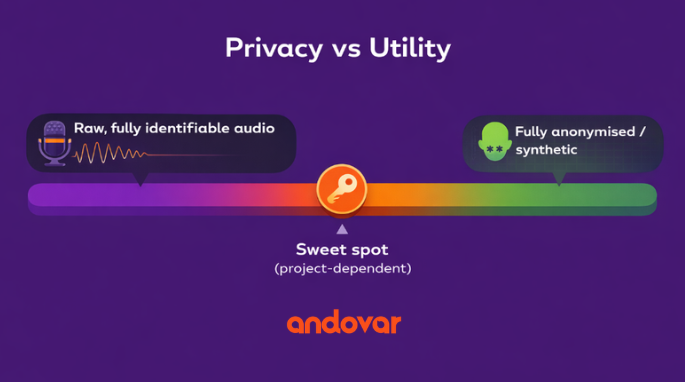
How do regulations affect voice data collection and use?
Voice data sits at the intersection of general privacy laws and biometric‑specific rules. Several privacy‑law explainers highlight keyframeworks that often apply:
- GDPR (EU) – Treats voice as personal data if it can identify someone. Requires explicit consent, data minimisation, rights of access/deletion, and privacy‑by‑design.
- CCPA and similar laws – Emphasise transparency about collection and usage, opt‑out choices, and rights over personal data.
- Biometric laws (e.g. BIPA in Illinois) – Cover biometric identifiers including voiceprints; typically require written consent, limit retention, and may grant a private right of action.
- Sector‑specific rules (e.g. HIPAA for health data) – Apply if speech includes protected health information and you’re a covered entity.
Articles aimed at voice‑AI builders including that of Illuma and Naitive, strongly recommend designing to the strictest applicable standard, encrypting all voice data, limiting retention, and documenting your privacy practices. That’sthe baseline we assume in Andovar projects, especially for finance, healthcare,and any use case that may involve biometric analysis.
Unsure which regulations apply to your voice data?
We can work with your legal and compliance teams to design custom speech data projects and multilingual voice data collection workflows that align with GDPR, CCPA, and biometric‑specific rules in your key markets.
Schedule a compliance review
How do fairness and non‑exploitation fit into ethics for speech data?
Ethics isn’t just about legal compliance; it’s about who benefits and who bears risk. Articles on ethics in speech data stress avoiding exploitation (for example, underpaying crowd workers or targeting vulnerable communities) and ensuring that datasets don’t systematically exclude or mis‑represent certain groups.
That means:
- Fair compensation and working conditions for contributors.
- Avoiding recruiting only “easy to access” populations if your system targets a much wider audience.
- Checking that performance isn’t much worse for certain accents, ages, or demographics.
We handle this by:
- Designing recruitment plans that reflect your actual user base, including low‑resource languages and less‑represented accents.
- Combining ethical sourcing with bias analysis, using the metadata and evaluation practices discussed in earlier chapters.
- Making fairness part of our success criteria for custom speech data and multilingual voice data collection projects, not just overall accuracy.
How do you implement “ethical‑by‑design” speech data collection?
Several resources including Datavesity now talk about ethical‑by‑design data collection: baking ethics into your process instead of patching issues later. For speech data, that usually looks like:
- Designing consent, minimisation, and security upfront.
- Building documentation and auditability into your workflows.
- Having clear escalation paths for participant concerns.
- Periodically revisiting your practices as regulations and norms evolve.
That’s essentially how we structure our projects:
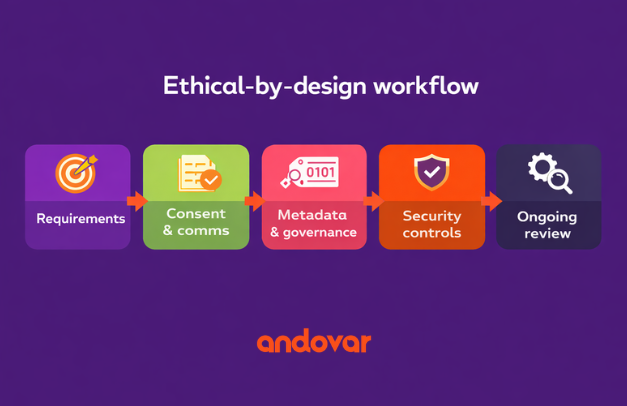
- Co‑define ethics and privacy requirements with clients (by market and use case).
- Draft consent and communication templates; localise them as needed.
- Set metadata fields for rights, consent, and retention.
- Implement technical safeguards (encryption, access control, logs).
- Review and update as laws and expectations change.
Andovar Use Case:
Ethical Speech Data for Global Telehealth Platform
Project Overview
Andovar delivered an ethically sourced 80,000+ sample speech dataset for a telehealth provider's multilingual consultation AI, covering English, Spanish, Hindi, Thai, and Arabic. The project prioritized privacy from intake to delivery, powering secure doctor-patient voice interactions across 12 countries.
Ethics Pillars Applied
- Informed consent: Multi-language consent forms (video + written) explained data use for AI training, withdrawal rights (anytime via portal), and zero retention post-anonymization—100% opt-in rate with revocable permissions.
- Transparency and data minimisation: Collected only essential clips (10-30s consultations), shared processing pipelines upfront, and deleted raw audio after annotation, retaining just de-identified features.
- Security and privacy-by-design: End-to-end encryption, role-based access in secure studios, pseudonymization (voiceprints stripped), and compliance with GDPR, HIPAA, and local laws like Thailand's PDPA.
- Fairness and non-exploitation: Paid above-market rates to diverse contributors (urban/rural, all ages/genders), audited for balance (no over-representation of any group), and excluded vulnerable participants.
Results and Impact
The AI achieved 94% accuracy in cross-cultural consultations without demographic biases, passed three regulatory audits unscathed, and earned user trust—boosting adoption by 35% in privacy-sensitive markets. Zero data breaches or complaints over 18 months.
FAQ
Q1. Why is voice data considered especially sensitive?
Because it can function as a biometric identifier and often contains personal, contextual, and emotional cues. Privacy and ethics resources emphasise that voice data can reveal identity, demographics, and even health signals, which is why many frameworks treat it as sensitive or biometric information.
Q2. What’s the minimum I should do to collect speech data ethically?
At a minimum: obtain explicit, informed consent; be transparent about use; minimise what you collect; secure it properly; and respect rights to access and deletion. These steps are repeatedly highlighted as essentials in speech‑data privacy and general data‑ethics guidance.
Q3. How do I know which laws apply to my speech data?
You need to consider where your users are, where you process the data, and what type of information is in the recordings. Overviews of voice‑AI privacy lawspoint to GDPR, CCPA, and biometric‑specific rules like BIPA as common touchpoints, especially for authentication or sensitive use cases. Your legal team can map these to your context; we can help you design compliant collection workflows.
Q4. Can I anonymise voice data completely?
You can reduce identifiability with techniques like masking and pitch shifting, but research on privacy vs utility in speech notes that complete anonymisation is hard, and there’s always a trade‑off between privacy and model performance.That’s why data minimisation, strong security, and clear consent remain important even when you anonymise.
Q5. How does Andovar support ethical speech data inpractice?
We design multilingual voice data collection and custom speech data projects with explicit consent, clear usage terms, localised communications, strong security, and robust metadata for rights and retention. We align with widely recognised best practices for speech data privacy and ethics, so you can show your stakeholders that your voice datasets are not only high‑quality, but also responsibly sourced.
About the Author: Steven Bussey
A Fusion of Expertise and Passion: Born and raised in the UK, Steven has spent the past 24 years immersing himself in the vibrant culture of Bangkok. As a marketing specialist with a focus on language services, translation, localization, and multilingual AI data training, Steven brings a unique blend of skills and insights to the table. His expertise extends to marketing tech stacks, digital marketing strategy, and email marketing, positioning him as a versatile and forward-thinking professional in his field....More