




Introduction
Most teams obsess over hours of audio and model architectures—then treat metadata as an afterthought. In practice, though, metadata is what makes your speech data usable: it tells you who's speaking, in which language, where the recording took place, on which device, and under what licence. Without that, even a huge, expensive corpus is just a pile of files you can't reliably query, slice, or defend to regulators—as audits show metadata gaps cause 30-50% inefficiencies in dataset prep time and raise compliance risks under GDPR/HIPAA.
Detailed guides on speech-data metadata and audio archives all stress the same point: rich, standardised metadata is essential for search, analysis, fair evaluation, and long-term governance of audio collections—turning static files into dynamic assets that boost model performance by enabling precise filtering (e.g., 20-40% WER improvements via targeted subsets).
In this article, we'll unpack the types of metadata that matter most for speech and audio datasets, share how we use them in Andovar projects, and show you how to treat metadata as part of your core speech data strategy, not an optional extra.
This article is part of our speech data strategy playbook—you can always jump back to the main overview for the full picture.
What is metadata in speech datasets, in practical terms?
If “metadata” sounds abstract, think of it as all the answers to questions you wish you’d asked when you recorded the audio: Who spoke? Where? On what device? Under what terms? Articles focused on speech‑data metadata define it as the structured descriptors that allow you to manage, search, and filter audio collections effectively.
For speech datasets, the most useful metadata usually falls into four buckets:
- Descriptive – Speaker age, gender, language, accent, region, topic of conversation.
- Technical – Sample rate, bit depth, file format, recording environment (studio, car, outdoor), device type.
- Administrative – Project name, data owner, licence type, consent flags, usage restrictions.
- Structural – Segment boundaries, speaker turns, links between audio, transcripts, and labels.
Third‑party resources on audio archives also highlight that this information can live either inside the audio files (like BWF/WAV chunks)or in an external database; many recommend a hybrid approach so you don’t lose critical metadata if files and databases drift apart.
At Andovar, we usually keep a central metadata schema in our project databases while also embedding key fields (like language and speakerID) directly into file naming and tags.
Why is metadata so critical for AI and model performance?
Metadata isn’t just for librarians; it has direct consequences for model quality. Articles on speech‑data management emphasize a few reasons why:
- Search and retrieval – You can quickly retrieve “female speakers aged 30–45 from region X, recorded in cars,” instead of guessing which files to use.
- Fair training and evaluation – You can build splits with no speaker leakage, and measure performance by accent, age, or environment.
- Targeted improvement – When you see a performance gap, you can identify which demographic or condition is under‑represented and collect additional custom speech data there.
- Governance and provenance – You can prove which data is consent‑based, what licence applies, and which regions or projects it came from.
One practical example from external guidance: richly tagged speech datasets enable precise filtering, like “isiZulu speakers from a specific province, recorded outdoors, with transcripts,” which would be impossible to isolate reliably without well‑designed metadata.
![[Infographic] – “What metadata unlocks” Simple vertical list graphic with arrows: Metadata → Searchability → Fair splits → Targeted retraining → Governance.](https://blog.andovar.com/hs-fs/hubfs/What%20metadata%20unlocks%20for%20speech%20data.png?width=500&height=750&name=What%20metadata%20unlocks%20for%20speech%20data.png)
What types of metadata should you prioritise for speech data?
You don’t need dozens of fields to get value; better to start with a solid core. Based on industry best practice and our own projects, a pragmatic starter set is:
- Speaker fields – Speaker ID, age band, gender, language, region/accent.
- Recording fields – Environment (studio, home, car, street), device type, sample rate, file format.
- Content fields – Prompt ID (for read speech), topic/domain, transcript availability, duration.
- Rights fields – Consent flag, licence type, project name, expiry or retention rules.
- Structural fields – Segment timestamps, speaker turns, link to annotation tasks.
Example metadata fields for a speech dataset 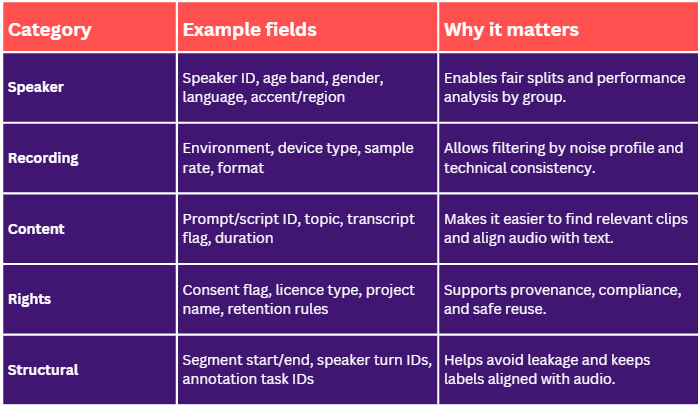
We tailor this schema per custom speech data project, but we always anchor it on these categories so datasets stay manageable as they grow.
Need a metadata schema that actually supports your AI roadmap?
We can help you design or retrofit metadata for existing speech datasets, and build new multilingual voice data collection projects with governance in mind from day one.
Talk to us about your speech metadata

How should you tag metadata: manually, automatically, or both?
A recurring theme in metadata guides is that you need abalance between manual precision and automated scale.
Manual tagging- Great for nuanced fields like region, accent, emotion, or domain labels.
- Still the “gold standard” when human context really matters, as several speech‑data metadata resources point out.
- But time‑consuming and costly to do exclusively.
- Ideal for basic technical fields and first‑pass content extraction.
- Common tools include
- Voice activity detection (VAD) for speech segments,
- Speaker diarisation for “who spoke when”,
- Acoustic analysis for noise and quality,
- ASR for draft transcripts,
- Language identification for language tags.
The sweet spot is a human‑in‑the‑loop workflow:use automation to propose tags and structure, then rely on humanreviewers—often via our multilingual data annotation services—tocheck and correct the high‑impact fields.
Want to upgrade metadata on an existing dataset?
We can combine automated tagging (for speed) with human review (for nuance) to enrich your current speech datasets with the metadata you wish you had from day one.
Upgrade your dataset metadata
How does metadata support ethics, privacy, and compliance?
Metadata is also where ethics and compliance become enforceable. Articles on audio data management and privacy point out that you should track not only who and what is in the recordings, but also what you’re allowed to do with them.
Key metadata fields for ethical speech data use include:
- Consent status – Was consent obtained, and for which purposes (training, evaluation, demos)?
- Licence type – Commercial vs research‑only, region‑restricted rights, etc.
- Sensitivity / restrictions – Flags for datasets that include health information, minors, or other sensitive content.
- Retention and deletion rules – How long you can keep the data, and what to do when consent is withdrawn.
This is why, in our multilingual voice data collection services and custom speech data projects,we treat licensing and consent as first‑class metadata, not just PDF attachments. It’s what allows you to answer future questions like “Which recordings can we legally use for this new model?” without combing through email threads.
How do you start implementing better metadata inpractice?
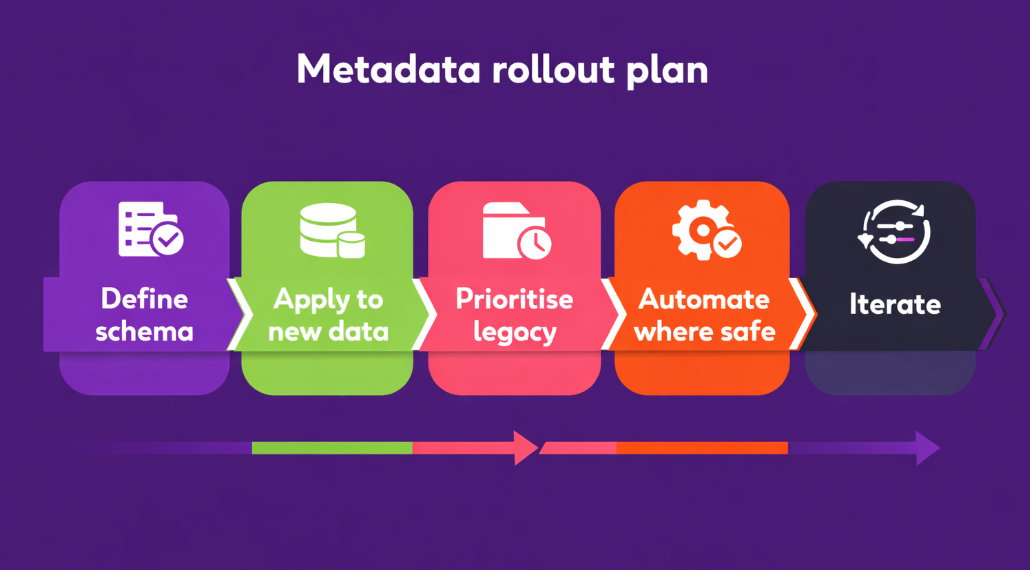
If your datasets are already large, you don’t have to boil the ocean. Audio‑archive best‑practice guides recommend a pragmatic approach:
- Start with a minimal schema that covers speaker, recording conditions, rights, and structural info.
- Apply it rigorously to all new data.
- Prioritise retro‑tagging for your most valuable or high‑risk legacy datasets.
- Use controlled vocabularies and standards where possible (for example, drawing on simple Dublin Core fields for administrative metadata).
- Document your schema so everyone—internal teams and external partners—tag data the same way.
That’s the pattern we follow when we help clients clean up legacy corpora and design new custom speech data projects: agree on the schema, apply it forward, then improve backward over time.
This blog is part of our speech data strategy playbook—you can always jump back to the main overview for the full picture.
Andovar Use Case:
Metadata-Enriched Dataset for Healthcare Voice Dictation
Project Overview
Andovar supplied a healthcare client with a 60,000+ sample speech dataset for clinical dictation and telemedicine AI, spanning 8 languages like English, Spanish, and Mandarin. Comprehensive metadata transformed raw audio into a searchable, compliant asset for training doctor-patient interaction models.
Metadata Types Applied
- Descriptive metadata (40%): Speaker profiles including age (20-70+), gender, medical role (doctor/nurse/patient), accent (e.g., US Southern, Indian English), and topic (symptoms, diagnoses, prescriptions)—enabling bias-free filtering for specialized training.
- Technical metadata (25%): Capture details like 48kHz sample rate, smartphone/clinical mic types, environments (quiet office vs. busy ER with beeps/murmurs), and noise levels for robust model conditioning.
- Administrative metadata (20%): GDPR/HIPAA consent status, anonymized IDs, licensing (commercial reuse permitted), collection dates, and audit trails to ensure regulatory compliance.
- Structural metadata (15%): Timestamps for speaker turns, segment boundaries (e.g., 5s clips), and linked transcripts for seamless alignment in annotation pipelines.
Results and Impact
The AI dictation tool reached 96% accuracy across accents and noise, with metadata enabling 3x faster dataset splits for fine-tuning. Compliance audits passed flawlessly, accelerating deployment in 200+ clinics and reducing manual transcription by 50%.
FAQ
Q1. Why is metadata for speech data so important?
Because it’s how you make large audio collections searchable, analyzable, and reusable. Detailed discussions of speech‑data metadata point out that without rich metadata, even extensive audio archives become unmanageable “black boxes”that are hard to query or govern.
Q2. What metadata fields should I start with if my dataset is small?
Begin with speaker (language, accent, age band), recording (environment, device, sample rate), rights (consent flag, licence type), and basic structural info (segment timestamps). You can always add more later; consistency matters more than sheer field count.
Q3. Can I rely entirely on automated metadata tagging?
Full automation is risky. Tools for VAD, diarisation, language ID, and draft transcripts are excellent starting points, but third‑party guidance warns that nuanced fields like region, accent, and emotion still benefit from human oversight. A human‑in‑the‑loop approach is usually best.
Q4. How does metadata help with fairness and bias?
It allows you to see which speakers and environments you have—and don’t have—inyour speech datasets, then measure performance by group. Without those tags, you can’t reliably detect or fix bias.
Q5. How can Andovar help with metadata on my existing datasets?
We can review your current corpora, propose a practical metadata schema, anduse our multilingual data annotation services plus automation to enrich your audio with the tags you need for search, evaluation, and compliance. For new projects, we’ll design multilingual voice data collection and custom speech data workflows with metadata built in from the start.

About the Author: Steven Bussey
A Fusion of Expertise and Passion: Born and raised in the UK, Steven has spent the past 24 years immersing himself in the vibrant culture of Bangkok. As a marketing specialist with a focus on language services, translation, localization, and multilingual AI data training, Steven brings a unique blend of skills and insights to the table. His expertise extends to marketing tech stacks, digital marketing strategy, and email marketing, positioning him as a versatile and forward-thinking professional in his field....More